Is Your Japan Itinerary Too Packed?
7 Warning Signs and How to Fix It
Introduction
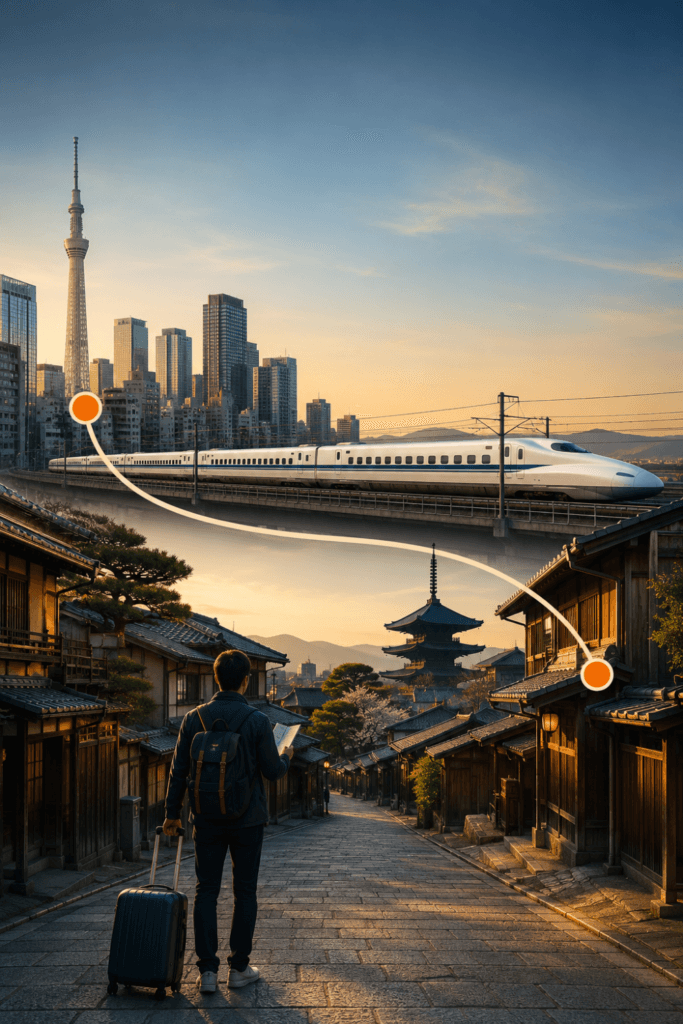
Japan is remarkably easy to travel around, but that efficiency can make an unrealistic itinerary appear achievable. A Shinkansen journey may look short on a timetable, yet the complete move also includes checking out, reaching the station, finding the correct platform, travelling to the next hotel, leaving luggage and becoming familiar with another area.
This is why an overpacked Japan itinerary is not always obvious. The problem is rarely one attraction on its own. It is the accumulation of hotel changes, cross-city journeys, fixed reservations, queues and tightly connected activities that leave no room for delays, weather changes or tiredness.
A good itinerary does not have to be slow. It should, however, remain workable when a train is missed, lunch takes longer than expected or you decide that a neighbourhood deserves more time.
This guide will help you examine an existing route, identify the days that are too demanding and simplify them without removing everything you are excited to experience.
Quick Answer: Is Your Japan Itinerary Too Packed?
Your Japan itinerary is probably too packed when several days depend on perfect transport, full energy and every activity proceeding exactly as planned. Other warning signs include changing hotels every one or two nights, combining distant districts, treating arrival and transfer days as full sightseeing days and having no clear answer to the question, “What can I skip if the day runs slowly?”
The best solution is not to remove attractions randomly. Start by protecting the main purpose of each day, reducing overnight bases that provide little benefit and grouping flexible activities around the same area.
Japan’s official tourism guidance supports this route-first approach. For trips of one week or less, the Japan National Tourism Organization recommends selecting one main base and using nearby excursions rather than relying on frequent long-distance travel and hotel changes. Read JNTO’s trip-planning guidance.
The seven signs below are a practical screening method rather than a scientific score. One difficult day does not automatically make an itinerary unrealistic, but a route deserves closer review when several signs appear repeatedly.
Research and Methodology
The recommendations in this guide combine official Japanese tourism, transport, luggage, weather and congestion information with a practical framework for reviewing first-time itineraries.
Official sources can confirm transport arrangements, visitor guidance and operating conditions. They cannot decide how many attractions every traveller should complete because walking tolerance, jet lag, interests and mobility needs differ.
Where no official rule exists, such as the ideal number of attractions per day, the advice is identified as a SoloTravelGlobe planning recommendation. The purpose is not to make every itinerary slow, but to expose the sections that only work when everything goes perfectly.
1. Arrival, Departure and Transfer Days Carry Major Sightseeing
Arrival day can look available when a flight lands in the morning, but the scheduled landing time is not the time you will reach the hotel. Immigration, luggage collection, airport transport and check-in arrangements can occupy a substantial part of the day.
Departure day creates similar pressure. Reaching Narita or Kansai International Airport safely may require leaving the city several hours before the flight, particularly when transfers or reserved trains are involved.
A major intercity transfer can still support a useful afternoon, but it should not carry the same expectations as a day that begins and ends in one city. If your Tokyo-to-Kyoto date also contains several distant Kyoto attractions and an evening reservation, the problem is the structure rather than the train speed.
2. You Change Hotels Every One or Two Nights
A one-night stay can be worthwhile when the accommodation is part of the experience. An onsen ryokan, temple lodging or remote destination may justify the additional check-out because staying there provides something a day trip cannot.
The warning appears when one-night stays become the normal pattern. Repeated packing, luggage arrangements, station navigation and hotel orientation reduce the time available for the destinations themselves.
A new base should improve the route in a measurable way. If it does not reduce commuting, support an important evening or provide a meaningful overnight experience, it may be an unnecessary stop.
3. Your Daily Route Crosses Several Distant Areas
Attraction count alone does not reveal how demanding a day will be. Four connected places can be easier than three attractions spread across opposite sides of Tokyo.
This is particularly important in Tokyo and Kyoto. Both cities contain famous sights across wide areas, and the route may involve different railway, subway and bus systems.
A day that repeatedly crosses the city can become exhausting even when each individual journey appears manageable. The relevant question is not only “How many places have I added?” but also “Do these places form one sensible route?”
4. Several Activities Have Fixed Starting Times
Reserved museums, observation decks, restaurants, tours and performances can give the day useful structure. The pressure begins when several bookings depend on precise movement between them.
A missed train or longer-than-expected visit can then affect every later reservation. The itinerary stops adapting to the traveller because the traveller must keep catching up with the schedule.
Timed activities are not the problem by themselves. The warning is a chain of commitments with insufficient travel allowance or a major cross-city journey between them.
5. The Schedule Excludes Ordinary Travel Needs
An itinerary containing only attraction opening hours and published train durations is incomplete. Meals, station exits, queues, toilet breaks, ticket collection, shopping and finding the correct bus stop all require time.
Food can disrupt the route when a famous restaurant is placed far from the day’s attractions or carries a long queue. A flexible lunch area is often more useful than making one restaurant essential.
Ordinary travel needs are not wasted time. They are part of the day, and ignoring them creates an itinerary that only works on a spreadsheet.
6. Every Activity Is Considered Essential
A realistic day needs at least one element that can be removed without destroying its purpose. If skipping any attraction makes the day feel like a failure, the schedule is carrying too many expectations.
This does not mean treating important experiences casually. It means deciding which one makes the day worthwhile and which supporting stops remain optional.
Making that decision before the trip is much easier than making it at four o’clock in the afternoon when you are tired, hungry and already behind schedule.
7. The Route Only Works in Good Weather and at Full Energy
Rain, summer heat, humidity, jet lag and accumulated walking can change how much sightseeing feels comfortable. A route that depends on ideal conditions is vulnerable even when the timetable appears reasonable.
There is no universal pace that suits every traveller. Someone who enjoys early mornings and long walking days may complete more than a person managing children, mobility concerns or a major time-zone change.
The itinerary should therefore include alternatives rather than assume that every day will begin with full energy. A nearby indoor attraction or shorter neighbourhood route can protect the day without forcing the original schedule.
Why Japan’s Efficient Transport Can Be Misleading
Japan’s transport network makes distant places look deceptively close. A journey shown as thirty minutes may not include walking to the station, waiting for the train, changing platforms, finding the correct exit or completing the final walk.
The complete transition usually looks more like this:
Hotel or attraction → station entrance → correct platform → train journey → transfer or exit → next entrance
When this process happens four or five times in one day, a substantial part of the day is spent moving rather than exploring. The physical effort also accumulates because large stations can involve long corridors, stairs and crowded platforms.
Crowding adds another variable. Japan’s Tourism Agency advises visitors to consider peak periods and, where suitable, visit popular places on weekdays, in the early morning or during the evening. See the official responsible-travel guidance.
This does not mean every attraction must be visited at sunrise. It means that congestion should be considered deliberately rather than assuming that a route will always move at the fastest possible speed.
Before finalising a long-distance transfer, compare the complete Tokyo-to-Kyoto journey rather than assuming the fastest advertised option automatically creates a light travel day.
Step 1: Count Your Usable Sightseeing Days
Begin by separating calendar days from usable sightseeing days. Mark every arrival, departure, hotel transfer, theme park and excursion that occupies most of the date.
| Day Type | How to Treat It |
|---|---|
| Full sightseeing day | Begins and ends in the same base without major transport |
| Arrival day | Includes immigration, luggage and airport-to-hotel travel |
| Departure day | Requires a protected margin for reaching the airport |
| Transfer day | Includes a hotel change or major intercity journey |
| Fixed full day | Theme park or excursion that consumes most of the date |
Seven hotel nights normally span eight calendar days, but they do not automatically provide eight complete sightseeing days. An afternoon arrival and morning departure may leave only six full days between the flights.
A Tokyo-to-Kyoto transfer does not necessarily remove the entire day. It changes the date into a partial travel day, so any sightseeing after arrival should remain geographically simple and flexible.
Once these days are labelled honestly, compare the remaining time with the number of cities and excursions in your draft. The guide to how many days you need in Japan for a first trip explains what five, seven, ten and fourteen calendar days can realistically support.
For a shorter route, you can also compare your plan against this realistic seven-day Japan itinerary. The objective is not to copy it exactly, but to see how many complete days remain after flights and transfers are considered.
Step 2: Audit Every Hotel Base
Write down every hotel base in travel order. Record how many nights it receives, why it is necessary, what it improves and how the luggage will move.
| Base | Nights | Reason for Staying | What It Improves | Luggage Plan |
|---|---|---|---|---|
| Tokyo | ||||
| Kyoto | ||||
| Osaka | ||||
| Regional extension |
A hotel move is useful when it shortens repeated travel, protects an important evening or creates a meaningful accommodation experience. It becomes questionable when it introduces another check-out without providing enough time or value at the destination.
Location also matters. Two hotels beside useful stations can occasionally be easier than one poorly positioned hotel requiring repeated long journeys, so the goal is not to apply one fixed maximum.
Does Luggage Forwarding Solve Frequent Hotel Changes?
Luggage forwarding reduces the physical burden of carrying large suitcases through stations. JNTO confirms that delivery is available at major airports and many major hotels, while accepted dimensions, delivery times and fees vary by provider. Review the official luggage and storage guidance.
The service does not remove the hotel change itself. You must still arrange delivery, keep essential items with you, check out and reach the next accommodation.
Do not build a transfer day on the assumption that every suitcase will arrive immediately. Confirm the arrangement with the sending and receiving hotels before deciding what must remain in your overnight bag.
If Kyoto and Osaka both appear as short hotel stays, reconsider whether the second move creates enough benefit. This Kyoto versus Osaka base comparison explains when using one city as the main Kansai base may be more efficient.
Step 3: Group Attractions by Area
Place every attraction on a map before deciding its order. The goal is not to find a mathematically perfect route, but to avoid unnecessary crossings that interrupt the day.
In Tokyo, Asakusa and Ueno combine more naturally than Asakusa and Shibuya. Meiji Jingu, Harajuku and Shibuya create another coherent route, while Tsukiji, Ginza and the Tokyo Station area can form a central-city day.
Crossing from eastern to western Tokyo can still be reasonable for one evening activity. The problem is repeatedly moving between distant areas because the itinerary follows the order in which attractions were discovered rather than their physical locations.
Kyoto requires similar care. Arashiyama, Fushimi Inari and Higashiyama occupy different parts of the city, while local buses and crowded streets can make short map distances take longer than expected.
Kyoto’s official visitor service provides area-based congestion forecasts and live information for popular locations. Check the Kyoto Travel Congestion Forecast when refining the date and time of your route.
Congestion information should help adjust a geographically sensible day. It should not create another complicated crossing simply because one distant attraction appears quieter.
Step 4: Mark Every Fixed Commitment
Identify every activity that requires a specific entry or starting time. These are the parts of the day that cannot move easily.
| Commitment Type | Examples | Planning Treatment |
|---|---|---|
| Hard commitment | Timed ticket, tour or restaurant reservation | Protect the arrival buffer |
| Soft priority | Important attraction without fixed entry | Keep flexible within its area |
| Optional stop | Shopping street, café or secondary viewpoint | Remove when the day runs slowly |
As a practical SoloTravelGlobe recommendation, keep one main fixed commitment on most days. This is not an official limit, and two reservations can work when they are nearby and separated by a generous interval.
Avoid placing a major cross-city journey between fixed bookings. The route should remain functional when the first activity takes longer or transport becomes crowded.
Give Theme Parks Their Own Day
Theme parks require a different planning approach. JNTO recommends allowing a full day for Universal Studios Japan and the surrounding CityWalk area. Read the official USJ planning guidance.
Tokyo Disneyland and Tokyo DisneySea should also be treated as full-day commitments when you intend to arrive early and remain into the evening. A park visit may affect the previous night and following morning because of the early start and extensive walking.
Do not attach substantial Osaka or Tokyo sightseeing to the park day. If you finish earlier than expected, treat the evening as a bonus rather than another required part of the itinerary.
Step 5: Create a Daily Cut Line
For each demanding day, identify one main anchor, a nearby supporting stop, an optional cut and a lower-effort backup.
| Day Element | Purpose |
|---|---|
| Main anchor | The experience that makes the day worthwhile |
| Supporting stop | A nearby activity that strengthens the route |
| Cut line | The first place to remove if the day runs slowly |
| Local backup | A café, museum, shopping street or short walk nearby |
The cut line should usually be the attraction that requires the largest detour while contributing the least to your interests. Duplicate viewpoints, secondary shopping districts and places added only because they are famous are often easier to remove.
A useful backup does not always mean returning to the hotel. A nearby indoor attraction or neighbourhood walk can keep the day enjoyable without forcing the original plan.
Check the JMA multilingual weather forecast near the travel date. When severe weather may affect transport or outdoor activities, use the official JMA warnings and advisories.
Flexible time is not wasted time. It lets you remain longer somewhere you enjoy, manage shopping and meals, or adjust the route when the weather changes.
Example 1: Repairing an Overpacked Tokyo Day
An ambitious Tokyo day might contain Senso-ji, Ueno Park, Tsukiji Outer Market, Meiji Jingu, Harajuku, Shibuya and Shinjuku.
Public transport connects all these places, but the route repeatedly moves between eastern, central and western Tokyo. It also assumes that meals, shopping and station navigation will take almost no time.
A stronger approach separates the city geographically:
| Day | Main Route | Optional Finish |
|---|---|---|
| Eastern Tokyo | Senso-ji → Asakusa streets → Ueno | Akihabara or a nearby evening |
| Western Tokyo | Meiji Jingu → Harajuku → Shibuya | Shinjuku if energy remains |
| Central Tokyo | Tsukiji → Ginza → Tokyo Station area | Flexible shopping or dinner |
The western route works because Meiji Jingu, Harajuku and Shibuya create a natural progression. Shinjuku can remain optional because it requires another move and may be more enjoyable on a separate evening.
If only one Tokyo day is available, choose eastern or western Tokyo according to your interests. Sampling both sides is possible, but it leaves less time to explore and little flexibility when the day runs slowly.
Example 2: Repairing an Overpacked Kyoto Day
A difficult Kyoto itinerary might combine Arashiyama, Kinkaku-ji, Nishiki Market, Fushimi Inari, Kiyomizu-dera and Gion.
The problem is not simply the number of attractions. They occupy western, northern, central, southern and eastern parts of Kyoto, so the plan depends on efficient trains, buses, walking and crowd conditions throughout the day.
A more coherent structure separates the city into area-based days:
| Day | Main Route | Optional Extension |
|---|---|---|
| Western Kyoto | Arashiyama riverside → Tenryu-ji → Sagano | Kinkaku-ji if timing supports it |
| Eastern Kyoto | Kiyomizu-dera → historic streets → Yasaka Shrine → Gion | Nearby evening activity |
| Southern Kyoto | Fushimi Inari → selected southern area | Central Kyoto if still practical |
Kinkaku-ji should remain optional after Arashiyama because it still requires another transfer. It should not force the western route into a rush simply because both attractions sit on the same side of Kyoto.
The eastern route works more naturally because the historic streets connect Kiyomizu-dera with Yasaka Shrine and Gion. This gives the area enough time to feel like a neighbourhood rather than a series of checkpoints.
Fushimi Inari can be protected on a separate morning or combined with another southern destination. It should not automatically be inserted between unrelated western and eastern Kyoto sights.
Example 3: Repairing a Ten-Day Multi-City Route
Consider a ten-day route containing Tokyo, Nikko, Kawaguchiko, Hakone, Kyoto, Hiroshima, Miyajima and Osaka.
Every destination is individually worthwhile, but the route contains several competing extensions. Nikko adds a substantial Tokyo day trip, Kawaguchiko and Hakone both introduce Mount Fuji or mountain-region travel, and Hiroshima with Miyajima requires meaningful time in western Japan.
The first repair is to protect the essential bases and decide which additional experience matters most. Choose a Tokyo excursion, a Mount Fuji or Hakone overnight, or a Hiroshima extension rather than expecting all three categories to fit comfortably.
Core-City Version
A manageable classic version might use four nights in Tokyo, three nights in Kyoto and two nights in Osaka. This provides nine hotel nights across ten calendar days, with arrival and departure completing the trip.
One carefully selected excursion can fit, but the route should not depend on several long-distance additions. The ten-day Japan itinerary provides a fuller example of how the major bases can be arranged.
Hiroshima-Priority Version
If Hiroshima and Miyajima are essential, a possible structure is four nights in Tokyo, three nights in Kyoto and two nights in Hiroshima. Osaka can then become a short visit or departure stop rather than another hotel city.
This is not automatically better than the core-city version. It demonstrates how choosing Hiroshima requires removing competing mountain stays or Tokyo excursions.
When too many cities remain, use the best cities in Japan comparison to identify which destinations genuinely match your interests. Fame alone is not a sufficient reason to weaken the complete route.
When a Fast Japan Itinerary Can Still Work
A fast itinerary can be realistic when the route moves mainly in one direction, uses conveniently located hotels and avoids frequent backtracking. Open-jaw flights, such as arriving through Tokyo and leaving through Kansai, can improve the structure substantially.
Light luggage and familiarity with public transport also help, but preparation does not eliminate the need for flexibility. Even an experienced traveller can face weather disruption, queues or an unexpectedly enjoyable place that deserves more time.
A busy route should therefore contain a recovery mechanism. This might be a slower morning, an optional attraction or one day that remains satisfying when a secondary stop is removed.
The goal is not to classify active travel as wrong. A fast itinerary becomes a problem when it lacks resilience and forces the traveller to catch up for several consecutive days.
Pace can also affect spending. Constant movement may increase the use of taxis, luggage storage, station meals and last-minute transport. The Japan travel budget breakdown explains how route and accommodation decisions can change the total cost.
Final Japan Itinerary Audit
Before reserving the remaining hotels and attractions, check the complete route against these questions:
| Question | A Workable Plan Usually Has |
|---|---|
| Are arrival and departure expectations realistic? | Only flexible local activities |
| Are transfer days lighter? | No full city itinerary after a major move |
| Does every hotel base have a clear purpose? | Better access or a meaningful overnight |
| Is each day geographically coherent? | One main area or direction |
| Are complete journey times included? | Walking, waiting, exits and meals |
| Are fixed bookings manageable? | Enough time to absorb a delay |
| Does every demanding day have a cut line? | One stop can disappear without ruining it |
| Is there a weather or low-energy alternative? | A nearby flexible option |
If several answers are unclear, do not begin by deleting random attractions. Identify the day’s main anchor, remove the least valuable detour and then reconsider whether the hotel base still makes sense.
A single unnecessary overnight can affect several dates because it introduces packing, transport and another arrival. Removing that stay may improve more of the trip than cutting several small attractions.
Conclusion
An overpacked Japan itinerary is not defined by being active. It becomes overpacked when the route depends on perfect transport, constant energy and every attraction proceeding exactly as planned.
Build the trip around usable sightseeing days, necessary overnight bases and geographically sensible routes. Protect one main experience each day, keep supporting stops flexible and decide in advance what can be removed.
A slightly shorter list can produce a fuller experience because more of the trip is spent experiencing Japan rather than trying to catch up with the itinerary.
Frequently Asked Questions (FAQs)
How many attractions should I plan per day in Japan?
There is no reliable universal number because a temple visit, theme park and neighbourhood walk require very different amounts of time. Geography and reservation requirements matter more than attraction count alone.
For many first-time visitors, one main experience followed by one or two nearby flexible stops provides a practical starting point. Additional activities can be added when they are close together and do not create another fixed commitment.
Is Tokyo, Kyoto and Osaka in seven days too packed?
The route is possible, but it creates a relatively fast first trip when arrival and departure are included. It works better with an open-jaw flight, two main hotel bases and firm limits on excursions.
Osaka does not always need to become a separate hotel stay. Visiting for an afternoon or evening from Kyoto may preserve more time, depending on your preferred experiences and departure airport.
How many hotel changes are too many?
There is no fixed maximum that suits every route. A hotel move is justified when it provides meaningful access, prevents repeated commuting or forms an important part of the experience.
A move becomes questionable when it creates another check-out without providing enough time or value at the new destination. Evaluate the complete transfer process rather than only counting nights.
Does luggage forwarding make a busy itinerary manageable?
Luggage forwarding can reduce the physical difficulty of moving between hotels, particularly when travelling with large suitcases. It can therefore make a necessary transfer more comfortable.
It does not fix a route containing too many destinations. You must still arrange delivery, carry overnight essentials, check out and travel to the next accommodation.
Should a Japan theme park receive a full day?
Major theme parks should normally receive a full day, especially if you want to arrive early, stay into the evening or use timed attraction access. The visit may also require a gentler following morning.
Avoid scheduling important city sightseeing after the park. If the evening remains available, treat it as flexible time rather than a required continuation of the day.
What should I remove first from an overpacked Japan itinerary?
Start with the attraction that requires the largest detour while contributing the least to your main interests. Repeated viewpoints, secondary shopping areas and places included only because they are famous are often the easiest cuts.
Next, review one-night stays and distant excursions. Removing one unnecessary hotel base can improve several days by eliminating packing, transfers and orientation work.
Disclosure: This post may contain affiliate links.


Compare prices across top platforms in seconds.