How Many Hotel Changes Should You Make in Japan?
Introduction
Choosing destinations is one of the enjoyable parts of planning Japan. Deciding how many of those destinations require a separate hotel is more difficult.
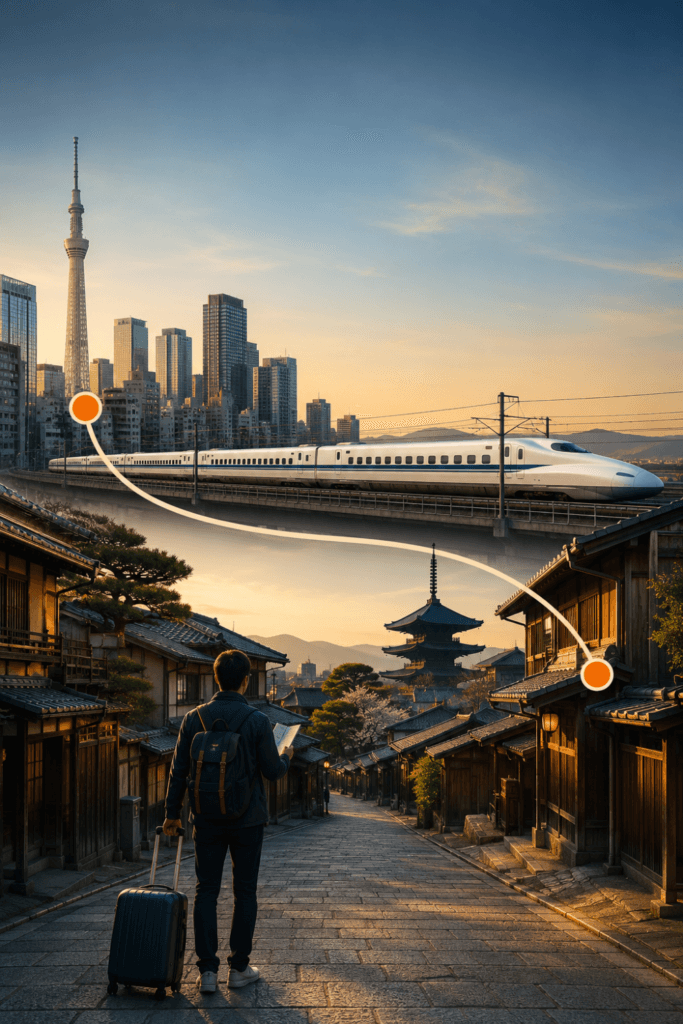
Japan’s efficient railway network makes frequent hotel changes appear manageable. Tokyo, Kyoto, Osaka, Hakone, Kanazawa and Hiroshima can all be connected on one itinerary, but a short train journey does not represent the complete effort involved in moving accommodation.
Every change includes packing, checking out, reaching the station, managing luggage, travelling to the next city, finding the new hotel and waiting for the room to become available. A hotel move may still be worthwhile, but it needs to improve the trip enough to justify this process.
This guide explains how many hotels usually work for a 5, 7, 10 or 14-day Japan trip, when one base is more practical and when a one-night stay adds something that a day trip cannot provide.
Quick Answer: How Many Hotels Do You Need in Japan?
For many first-time trips, a practical starting range is:
| Trip length | Suggested number of hotels | Hotel changes |
|---|---|---|
| 5–7 calendar days | 1–2 hotels | 0–1 |
| 8–10 calendar days | 2–3 hotels | 1–2 |
| 11–14 calendar days | 3–4 hotels | 2–3 |
| More than 14 days | Plan by region | Depends on the route |
These are SoloTravelGlobe planning recommendations, not official limits. A seven-day Tokyo trip may need only one hotel, while a seven-day open-jaw route from Tokyo to Kyoto may work better with two. A 10-day trip could justify a third stay when one night is spent at an onsen ryokan, but the same number of hotels may feel excessive if all three are located within the same urban region.
JNTO recommends using one principal base for trips of one week or less and minimizing long-distance travel and hotel changes. It suggests that approximately 10 days to two weeks provides more room for the classic Tokyo, Kyoto and Osaka route. Read JNTO’s official trip-planning guidance.
The most useful rule is not “stay at least three nights everywhere.” Instead, ask whether changing hotels improves the following days enough to justify packing and moving.
How This Guide Was Prepared
The recommendations in this article combine official Japanese tourism, railway and luggage information with a practical method for comparing overnight bases. Official sources establish what services and restrictions exist, while the suggested hotel ranges are editorial guidance designed for first-time independent travellers.
No single range will suit every route. A traveller using a small backpack can change hotels more easily than a family carrying several suitcases. Someone who deliberately wants to experience a mountain ryokan may accept a one-night stay that would make little sense at an ordinary business hotel.
Count Overnight Bases, Not Destinations
A destination does not automatically require a hotel. Nara can be visited from Kyoto or Osaka, Kamakura from Tokyo, and Kobe from Osaka without packing and checking out.
This distinction matters because travellers often give every city an overnight stay simply because it appears as a separate destination on the itinerary. The result may look balanced on paper while creating more work than necessary.
Before adding a hotel, decide whether the place is a day trip, a useful overnight base or a stop visited while travelling between two bases. The overnight option should provide a benefit that cannot be achieved easily by returning to the existing hotel.
Why a Hotel Change Takes Longer Than the Train Journey
Suppose the railway journey between two cities takes thirty minutes. The real move begins before the train departs and continues after it arrives.
You may need to finish packing, check the room, complete check-out, walk to the station and find the correct platform. At the destination, you still need to reach the hotel, leave luggage and become familiar with another neighbourhood. If the room is not ready, you must either return later or carry the items you need for the day.
A short railway journey can therefore occupy much of the morning once the complete door-to-door process is included. This does not make the move a mistake, but the sightseeing plan around it should be lighter than a normal full day.
How Many Hotels for a 5-Day Japan Trip?
Five calendar days usually provide only three or four full sightseeing days after arrival and departure are considered. One hotel is therefore the most practical choice for most five-day trips.
Tokyo can support the entire visit through different neighbourhoods and an optional day trip. Osaka can also work as a base for a Kansai-focused trip containing Osaka, Nara, Kobe or selected Kyoto sightseeing.
Two hotels can still make sense when the flights create a natural one-way route or when the second stay is the main purpose of the trip. For example, three nights in Tokyo followed by one night at a nearby onsen destination may work when the return airport transfer remains comfortable.
Adding a third hotel to five days usually leaves too little time to benefit from each base. The itinerary may technically cover more places, but much of the visit becomes a sequence of arrivals and departures.
How Many Hotels for a 7-Day Japan Trip?
One or two hotels are usually sufficient for seven calendar days. The answer depends heavily on whether the international flights arrive and depart from the same region.
A round-trip Tokyo journey works well with one hotel, especially when the visitor wants time for Tokyo neighbourhoods and a day trip. Staying in the right area is more important than changing hotels across the city; this where to stay in Tokyo guide compares the most practical areas for a first visit.
Two hotels can support a Tokyo–Kyoto route when the traveller arrives in Tokyo and departs from Kansai, or follows the reverse direction. The open-jaw flight removes the need to return to the original city and gives the hotel change a clear purpose.
A third hotel is harder to justify unless it provides a distinctive experience. Tokyo, Hakone and Kyoto can work when the Hakone night is centred on a ryokan and onsen rather than being another brief sightseeing stop. Tokyo, Kyoto and Osaka may be possible too, but a separate Osaka hotel is not always necessary when the Kansai portion is short.
The Japan 7-day itinerary shows how the number of bases affects the daily pace.
How Many Hotels for a 10-Day Japan Trip?
Two or three hotels are a strong starting point for ten calendar days. This gives each major base time to support more than one full sightseeing day while allowing one meaningful extension.
A straightforward route might use four nights in Tokyo and five nights in Kyoto, with Osaka visited for a day or evening. Another version might divide Kansai between Kyoto and Osaka when both cities have several important plans.
Three hotels work particularly well when the route includes Tokyo, a one-night onsen stay and Kyoto. In this version, the middle accommodation is not merely a bed. Dinner, bathing, the surrounding scenery and a slower evening become part of the experience.
Four hotels can work, but the fourth needs a clear benefit. Adding Osaka because of repeated late evenings, Universal Studios Japan or an early Kansai Airport departure may be reasonable. Adding Osaka solely to give the city its own line on the hotel list is a weaker reason.
The Japan 10-day itinerary provides a useful comparison for a first-time route at this length.
How Many Hotels for a 14-Day Japan Trip?
Three or four hotels usually provide a comfortable balance for a 14-day trip. This allows the itinerary to expand beyond Tokyo and Kansai without turning every second day into another transfer.
One possible route is Tokyo, Kanazawa, Kyoto and Osaka. Another could use Tokyo, an onsen destination, Kyoto and Hiroshima, with Osaka visited without an additional stay or used only as the final base when the departure flight makes that more convenient.
Five hotels are not automatically excessive over two weeks. The route can remain manageable when it moves in one direction, most bases receive at least two nights and one shorter stay offers an experience that depends on sleeping there.
Problems begin when the route contains several consecutive one-night stays. Even with luggage forwarding, repeated check-outs leave little time to understand each place and make the itinerary vulnerable to delays.
When Changing Hotels Improves the Trip
The Move Prevents Repeated Commuting
A new hotel is useful when it eliminates the same long return journey on several days. If most mornings begin in Kyoto and most evenings finish there, sleeping in Kyoto is usually more sensible than commuting from Osaka every day.
The same reasoning applies in reverse. Osaka may be the stronger base when the itinerary prioritizes Universal Studios Japan, nightlife, westward day trips or Kansai Airport access.
If you are deciding whether to split the region, this guide to using Osaka as a base or a day trip from Kyoto examines that decision in greater detail.
Sleeping There Improves Early Mornings or Evenings
Some destinations feel different after day visitors leave or before the busiest period begins. Staying locally may provide a calmer morning, a more relaxed dinner or access to an activity that would be awkward from another base.
This benefit needs to match the traveller’s actual plans. An early start has little value if you prefer slow mornings, while a lively Osaka night may not justify moving if nightlife is not important to you.
The Accommodation Is Part of the Experience
A ryokan, temple lodging or remote countryside stay can justify a one-night move because the accommodation contributes to the trip. JNTO describes ryokan as traditional inns where the experience may include tatami rooms, bathing, multi-course dinner and breakfast. Read JNTO’s Japanese ryokan guide.
Temple lodgings can provide a different reason to stay overnight, including quiet surroundings and optional religious or cultural activities. These stays should be selected because the experience is meaningful to you, not merely to increase the number of accommodation styles. Learn about temple stays through JNTO.
The Move Continues in the Direction of Travel
Hotel changes are easier to justify when the itinerary moves naturally from one region to another. Tokyo to Kyoto to Hiroshima is more efficient than Tokyo to Hiroshima to Kyoto and then back to Tokyo.
Flight selection affects this decision. Arriving through one region and departing through another can remove backtracking and make a second or third base more useful.
The Final Base Makes Departure Safer
A final hotel change may be worthwhile when an early flight would otherwise require a complicated pre-dawn journey. The benefit is not necessarily staying directly beside the airport; it may be enough to move to a city or station with a simpler direct connection.
Do not add an airport hotel automatically. If the existing accommodation already has a reliable route and the flight leaves later in the day, moving for the final night may create more inconvenience than it removes.
When One Base Is the Better Choice
One base is usually stronger when the destinations are close enough for comfortable day trips and the trip is short. Kyoto and Osaka are well connected, so a visitor with only three or four Kansai nights may gain more from choosing the better base than dividing the stay.
Staying in one hotel also helps when luggage is large, mobility is limited or several members of the group need time to pack. Returning to a familiar station and room each evening reduces the number of small decisions required during the trip.
Changing hotels within the same city is rarely necessary on a short first visit. Moving from Asakusa to Shinjuku may provide a different atmosphere, but Tokyo’s railway network usually makes it easier to choose one well-connected area. A split stay becomes more reasonable during a longer visit or when the second hotel supports a specific experience, airport journey or theme-park visit.
Use the individual accommodation guides when selecting a base:
- Where to stay in Kyoto for first-time visitors
- Where to stay in Osaka for first-time visitors
- Where to stay in Tokyo for first-time visitors
When a One-Night Stay Is Worthwhile
A one-night stay works best when the evening and following morning provide the main value. An onsen ryokan with dinner, bathing and breakfast is a good example because returning to a city hotel would remove much of the experience.
Temple stays, mountain destinations and small islands can also justify one night when the accommodation gives access to early activities or a quieter atmosphere. In these situations, the hotel is not simply replacing another hotel; it is enabling the reason for visiting.
A one-night city stay is less convincing when you arrive late, leave early and have no evening or morning plans. If the destination receives only a few hurried hours, consider visiting it as a day trip or removing it until a future journey.
Before booking a ryokan, check its meal and arrival conditions carefully. Properties that serve dinner may require arrival by a particular time, and dietary requests may need advance notice.
Four Ways to Handle Luggage Between Hotels
Carry Everything With You
Carrying your luggage provides complete control and removes delivery uncertainty. It works best with a backpack or manageable suitcase, straightforward railway connections and accommodation close to stations.
Large luggage makes station transfers, stairs and crowded local transport more difficult. On the Tokaido–Sanyo–Kyushu Shinkansen, baggage with combined dimensions over 160 centimetres currently requires a reserved seat with appropriate oversized-baggage space. Check JR Central’s current luggage rules.
Forward Luggage to the Next Hotel
Japan’s luggage-delivery services can send suitcases between many hotels, airports and designated counters. This is particularly useful when the route includes a one-night stop and the main suitcase can be sent directly to the following base.
Do not assume every delivery will arrive on the same day. Timing, size limits, fees and property acceptance vary. Confirm arrangements with the sending hotel, receiving hotel and carrier, then keep medication, travel documents, valuables and overnight essentials with you.
JNTO provides an overview of available delivery and storage services in its official luggage guide.
Use Hotel Storage or Station Lockers
Many hotels allow guests to leave luggage before check-in or after check-out, but this is a property policy rather than a universal entitlement. Vacation rentals and unattended accommodation may not provide storage at all.
Station lockers can help during a transfer, but large lockers may fill quickly at busy locations. Research the station layout and a backup facility before depending on one particular locker bank.
Keep the Main Hotel and Travel With an Overnight Bag
For a short excursion, some travellers retain their main hotel room and take only an overnight bag. This removes the need to pack completely and guarantees a room when they return.
The disadvantage is paying for two accommodations on the same night. This approach is usually justified by convenience or a special overnight experience rather than savings, so compare the additional room cost with forwarding, storage and transport alternatives.
Three Worked Hotel Plans
Seven Days: Tokyo and Kyoto
A seven-day open-jaw trip can use two hotels: Tokyo first and Kyoto second, with departure through Kansai. The single hotel change moves the traveller toward the final airport and gives both cities useful mornings.
If the flights both use Tokyo, adding Kyoto creates a return journey near the end. The route may still be worthwhile when Kyoto is the main priority, but it should be compared with a one-base Tokyo trip containing closer day trips.
Ten Days: Tokyo, Hakone, Kyoto and Osaka
One version uses Tokyo for four nights, Hakone for one night and Kyoto for four nights. Osaka is visited from Kyoto without adding a fourth hotel. The Hakone stay is justified by the ryokan experience, while Kyoto remains the main Kansai base.
A different traveller may prefer four Tokyo nights, three Kyoto nights and two Osaka nights. This split is stronger when Osaka contains several evening plans, Universal Studios Japan or the most convenient departure route.
Neither arrangement is universally better. The correct version depends on whether the onsen night or the separate Osaka base provides more personal value.
Fourteen Days: Tokyo, Kanazawa, Kyoto and Hiroshima
Four hotels can work comfortably when the route moves from Tokyo to Kanazawa, then Kyoto and Hiroshima. Each change introduces a genuinely different region and avoids repeatedly returning to an earlier base.
Adding Hakone, Osaka and another one-night destination would raise the total to seven hotels. That version may still be physically possible, but it requires much more packing and leaves little room for weather changes or slower days. The better adjustment is usually to choose one special overnight extension and spend longer in the main regions.
How Hotel Changes Affect Your Budget
Changing hotels may create costs beyond the room price. These can include luggage forwarding, station lockers, local transport, seat reservations and meals purchased for convenience during the move.
A cheaper hotel is not automatically better value if it requires a long journey on several mornings. Compare the total accommodation price with the transport cost and time created by the location.
The Japan travel budget breakdown explains how accommodation location and route choices affect overall spending.
Decide Your Bases Before Choosing Individual Hotels
Choose the overnight cities and approximate number of nights before comparing individual properties. Booking an attractive hotel too early can cause the itinerary to bend around the reservation rather than the other way around.
Once the bases are settled, compare station access, room policies, luggage services and the actual places you intend to visit. A smaller room in the right location often supports the trip better than a larger room requiring inconvenient daily transfers.
Season also affects availability and price. The guide to when to book Japan hotels explains which reservations deserve earlier attention and when flexible rates are particularly useful.
A Final Hotel-Change Test
Before confirming each accommodation, ask what becomes easier because you are sleeping there. The answer should be more specific than “we want to see the city.”
Check whether the move removes repeated commuting, improves an important morning or evening, provides a meaningful accommodation experience, continues in the direction of travel or simplifies airport access. Then confirm how luggage will move and what sightseeing remains realistic on check-out day.
If the new hotel provides little benefit beyond dividing the nights evenly, keep the existing base. If it improves several days or enables an experience that cannot be reproduced as a day trip, the move is probably worthwhile.
Conclusion
Most first-time Japan trips do not need a new hotel for every destination. One or two hotels usually suit a 5–7 day visit, two or three work well for 8–10 days, and three or four provide a practical starting point for 11–14 days.
The number matters less than the reason behind each move. Change hotels when doing so improves several days, unlocks a meaningful overnight experience or creates a more natural one-way route. Keep one base when the move only adds packing without making the trip noticeably better.
Frequently Asked Questions (FAQs)
How many hotels should I book for seven days in Japan?
One or two hotels are sufficient for most seven-day trips. One hotel works well for a Tokyo-focused or Kansai-focused visit, while two support a simple open-jaw route such as Tokyo to Kyoto.
A third hotel should usually provide a distinct benefit, such as an onsen stay, rather than functioning as another brief city stop.
Are three hotels too many for a 10-day Japan trip?
Three hotels can work well over ten days when each has a clear purpose. Tokyo, an onsen destination and Kyoto is a reasonable pattern because the middle stay offers a different experience.
Three short city stays may feel less rewarding if they create repeated transfers without improving the sightseeing route. Assess the value of each move rather than relying only on the number.
Should I stay in both Kyoto and Osaka?
Stay in both when you have enough Kansai nights and several plans that benefit from sleeping in each city. Early Kyoto sightseeing followed by multiple Osaka evenings, Universal Studios Japan or a convenient Kansai Airport departure can justify the split.
Choose one base when the Kansai stay is short or one city clearly dominates the itinerary. Osaka can be visited from Kyoto, and Kyoto can be reached from Osaka, although the complete hotel-to-attraction journey matters more than the train time between major stations.
Is a one-night ryokan stay worth changing hotels?
It can be worthwhile when the ryokan experience is one of the trip’s priorities. Bathing, dinner, a quiet evening and breakfast may provide value that a daytime visit cannot reproduce.
The stay is weaker when the traveller arrives too late for dinner and leaves before enjoying the facilities. Check arrival requirements and meal schedules before fitting the ryokan into a transfer day.
How does luggage forwarding work between Japan hotels?
Many staffed hotels can help arrange delivery to another hotel. You normally provide the destination details, complete the shipping form and pay according to the luggage size and route.
Delivery is not automatically immediate. Confirm how long it will take, whether the receiving accommodation accepts deliveries and what name or reservation details must appear on the form.
Will hotels store luggage before check-in or after check-out?
Many hotels provide this service, but policies vary. Some only store luggage on the day of arrival or departure, while unattended properties and vacation rentals may have no storage facilities.
Contact the property directly when storage is essential to the itinerary. Do not rely solely on assumptions from another hotel stay.
Should I change hotels within Tokyo?
Most first-time visitors do not need to change hotels within Tokyo during a short stay. Selecting one well-connected area reduces packing while the rail and subway systems provide access to different neighbourhoods.
A split stay can make sense on a longer trip or when the second hotel serves a specific purpose, such as a resort, airport transfer or several activities concentrated in another part of the metropolitan area.
Should I book an airport hotel for my final night?
An airport hotel can be useful for an early flight, a difficult pre-dawn connection or travellers who want a simpler final morning. It may also help after a late arrival when continuing into the city would provide little benefit.
For a later flight with a direct connection from the existing hotel area, moving solely for the final night may be unnecessary. Compare the complete morning journey before adding another check-out.
Disclosure: This post may contain affiliate links.


Compare prices across top platforms in seconds.